
IACLEA Horus Intelligence Update
Selected Horus Alerts
- On 18 June 2026 outside Paris Charles de Gaulle Airport, Paris Orly Airport and Paris Le Bourget Airport, Paris, France: Confédération française démocratique du travail is due to stage a demonstration, as part of an industrial action to call for better working conditions for baggage handlers, cleaners, retail workers and other ground-operations staff.
- On 14 June through the streets of Gothenburg, Sweden: At least 20 individuals affiliated with Extinction Rebellion Sverige staged a march against the alleged ‘climate crisis.’
- On 17 June 2026 outside Palma de Mallorca Airport, Autopista de Llevant, Palma, Illes Balears, Spain: A demonstration is due to be staged, as part of an industrial action to call for improved working conditions for workers who provide assistance to passengers with reduced mobility.
Global Flashpoints
To view more alerts, tailored to your Campus please click on the following link:

Thought Leadership
Horus will be releasing a series of sharing informative content. Please click on the links below and revisit this page for more in the coming months.
Putin is running out of men to stuff into the meat grinder. Korean drone-bait can’t save him
The fall of Assad is a disaster for Putin. More dominoes may fall across the Middle East
Sinwar’s death is an Osama bin Laden moment. There is now real hope that the guns will fall silent
Education Establishments – Crime U.S.A
Figures sourced from the Department of Education suggest that a major campus‑crime analysis published in 2025 showed:
• A 13% rise in campus crime between 2022–2023 (latest government data available).
• 22,212 crimes were reported across 635 institutions.
Most common on-campus crimes (2023) identified as:
• Motor vehicle theft: 8,109 incidents (37%)
• Burglary: 4,283 (19%)
• Rape: 3,939 (18%)
• Fondling: 3,207 (14%)
• Aggravated assault: 1,788 (8%)
• Murder: 20 (<1%)
Impact of the Middle East conflict
Antisemitic crime
In 2024, there has been a notable rise in antisemitic incidents at U.S. universities. According to the Anti-Defamation League (ADL), there were 2,087 anti-Israel incidents reported on college campuses between June 1, 2023, and May 31, 2024. These incidents included assaults, vandalism, harassment, protests, and divestment resolutions. This increase has significantly affected Jewish students and communities across various campuses.
Pro-Palestine encampments
Following the Israeli response to the Hamas attack of 7th October 2023, and subsequent invasion of Gazza a number of student encampments were established at Universities in the USA. Unofficial reporting suggests that in May 2024 there were occupations, walkouts, or sit-ins on nearly 140 campuses across the United States, with students demanding universities divest from Israel and address other related issues.
Outlook
It is assessed that at present there is unlikely to be any cessation of protests moving into 2025. Protesters may, having seen the university’s response to encampments, shift away from establishing new encampments in order to explore other forms of direct action or protest to promote the cause. However, from research undertaken, it is also apparent that in some cases others see encampments as a success in highlighting their campaign and may consider a potential return.
Active Shooter Incidents
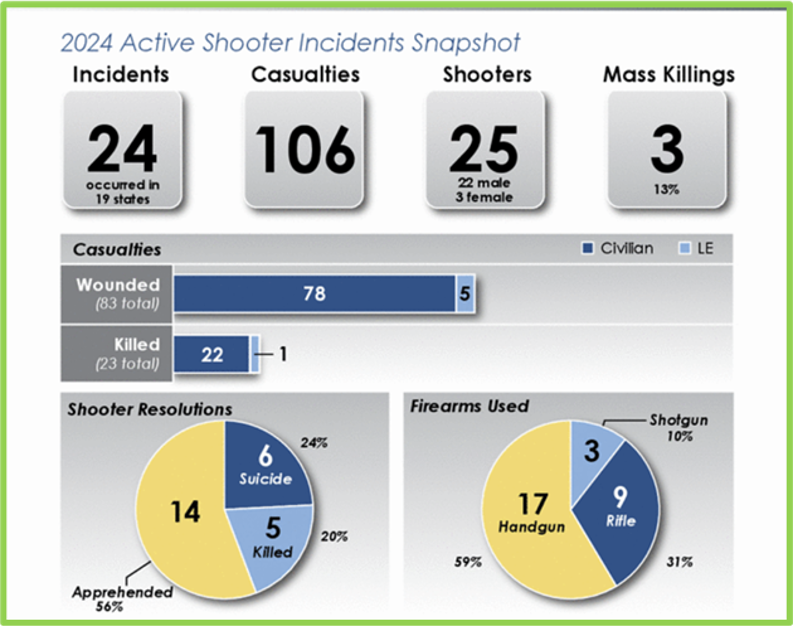
In 2024, the FBI designated 24 shootings as active shooter incidents. The 24 active shooter incidents in 2024 occurred in 19 states and represent five location categories, including open space, commerce, education, government, and houses of worship. However, overall incidents decreased by 50% from 2023 (48 incidents).
The highest number of incidents occurred in Texas (4) followed by California and North Carolina, each with 2.
Incident data suggests that the month of June (5) had the highest number followed by September (4). Incidents were more likely to occur between 06:00 am and 11:59 am, of these incidents four took place in education establishments (17%). The data identifies that those involved (assailents) were between the ages 14 and 73 years old.
Mass Shooting Incidents
Mass shootings are incidents in which several people are injured or killed due to firearm-related violence. Since January 01, 2026, a total of 175 people have been killed and 695 people have been wounded in 170 shootings, as of May 31, 2026.
There is no generally accepted definition of a mass shooting and several organizations have differing definitions for the term. For the purposes of this report, a mass shooting incident refers to one in which there are a total of four or more victims, and only incidents considered mass shootings by at least two of the organizations that monitor instances are included. The Gun Violence Archive, a nonprofit research group that tracks shootings and their characteristics in the US, indicates that mass shootings are down to pre-COVID levels, following a significant rise between 2020-2023
Education Establishments – Terrorism U.S.A
In 2024, there has been a notable rise in antisemitic incidents at U.S. universities. According to the Anti-Defamation League (ADL), there were 2,087 anti-Israel incidents reported on college campuses between June 1, 2023, and May 31, 2024. These incidents included assaults, vandalism, harassment, protests, and divestment resolutions. This increase has significantly affected Jewish students and communities across various campuses.
Furthermore, the recent terrorist attack in Germany and that by a lone actor on New Year’s Eve in New Orleans is a reminder that the threat from International terrorism remains.
Overseas Study – United Kingdom
Crime
The UK is generally considered a safe place to live, with crime rates lower than many countries, particularly in terms of violent crime. However, it has higher rates of certain crimes like fraud and computer misuse compared to some European neighbours. There has been a notable decrease in overall crime since 1996.
As of June 2026, the crime rate in the UK (excluding Scotland) is 72 per 1,000 people, with England having the highest rate at 68 per 1,000 people. Crime statistics for UK universities are less centralised but research by the online publication Unifresher, published in early 2026, indicate that crime rates vary significantly across different institutions. The publication identified what they termed as the top ‘dangerous’ universities, although it is worth noting that this is based on crime and the location of the campuses. The research indicates that city-based universities often report higher crime levels than smaller town or rural universities with the patterns consistent with population density, student presence, and commercial activity, particularly the night-time economy.
Terrorism
The threat to the UK (England, Wales, Scotland, and Northern Ireland) from terrorism was raised to SEVERE on April 30, 2026, meaning an attack is highly likely and could occur without warning.
The level was raised following a stabbing attack on two clearly visible Jewish men in north London on April 29, 2026 and driven by an increase in broader Islamist and extreme right wing terrorist threat from individuals and small groups based in the UK and increased state-linked physical threats which is encouraging acts of violence, including against the Jewish community.
Terrorists are increasingly using less sophisticated methods of attack, including knives, firearms, and vehicles, to target crowded places more effectively. Terrorist groups continue to use social media to inspire or direct ‘lone wolf’ attacks which are difficult to predict and disrupt and could take place in almost any country.
Antisemitism
There continues to be high levels of antisemitism in the UK, exacerbated by conflict in the Middle East. In addition to the stabbing attack detailed above, March and April 2026 saw the emergence of Harakat Ashab al-Yamin al-Islamiyya, a likely front group for Iranian state-sponsored terrorism, which claimed responsibility for six low-level arson attacks of Jewish linked locations in London.
These incidents are part of a trend for state actors to use young proxies rather than its own operatives to conduct low-tech intimidatory attacks. These ‘gig-economy’ attacks are low-cost and likely designed to generate outsized impact. The Community Security Trust (CST) recorded 3,700 antisemitic incidents in 2025; the second highest logged by the organisation.
Antisemitic incident levels remain at a significantly higher rate than was the case prior to Hamas’ terror attack on Israel on October 7, 2023. There was an immediate and significant spike in recorded cases of anti-Jewish hate in the UK in the aftermath of that attack. The subsequent war, and its grip of public and media attention even during periods of ceasefire, has continued to impact the amount and nature of anti-Jewish hate reported in the 27 months since that date.
Espionage
The UK is a high priority espionage target for Hostile foreign intelligence services (FIS) and the threat from espionage to the UK government is assessed to be SEVERE, espionage is highly likely to occur. Hostile FIS are almost certain to seek to gather intelligence on a broad range of subjects, including foreign policy, defense, financial, technological, industrial, and commercial interests.
Terrorism – Middle East Outlook
There remains a heightened risk of conflict between Iran and the US, despite both sides holding indirect talks in Oman and further talks planned in Switzerland this week. Any conflict would almost certainly result in significant disruption to travel in the region, with airspace closures and the cancellations of civilian airline flights. There is an increased risk of Iranian ballistic missiles being fired at short to no notice in response to any US intervention, targeting Israel and US interests in the region. Israel’s Iron Dome antimissile infrastructure is advanced and robust, and most missile, rocket, and drone attacks are intercepted, many before reaching Israeli airspace.
There is an extensive warning siren network and hardened shelters that protect citizens and visitors but there remains a risk of a falling debris from intercepted missiles, rockets and drones. There is a continued threat of indiscriminate terrorist attacks in Israel, particularly at transport hubs.
On 11 February, following a meeting with Prime Minister Netanyahu in Washington, President Trump said “nothing definitive” was decided about dealing with Iran’s nuclear programme, but that negotiations with Iran would continue. A subsequent report in The Economist claimed Netanyahu’s visit to Washington disappointed him, saying before returning to Israel that he had not hidden his “general scepticism about the possibility of reaching any agreement with Iran”. Earlier, during a speech to mark the 47th anniversary of the Islamic revolution, Iran’s president said he was prepared to allow nuclear inspections and reiterated that the country was not building an atomic weapon. On 13 February, President Trump said he was sending a second aircraft-carrier, the USS Gerald R Ford, to the Middle East, “in case we don’t make a deal” with Iran on its nuclear programme and called for regime change in Iran.
On 14 February, US Secretary of State Marco Rubio said President Trump preferred a deal, but it was “very hard to do” one with Iran. Iran’s deputy foreign minister, in an interview with the BBC, said Iran is ready to consider compromises to reach a nuclear deal with the US if the Americans are willing to discuss lifting sanctions, saying the ball was “in America’s court to prove that they want to do a deal.” Iran is refusing to discuss limits to its ballistic missile programme. The second round of indirect talks between the US and Iran will take place on 17 February in Geneva.
Israel/Iran Conflict Updates
Background – On February 28, 2026, Israel and the US launched coordinated Operations Roaring Lion (Israel)/Epic Fury (US), a “massive” attack against Iran’s leadership and military. Iran’s Supreme Leader, Ayatollah Ali Khamenei, was among 50 senior Iranian military leaders killed in the initial attack. Israel’s Defence Minister said that Israel had “launched a pre-emptive strike against Iran to remove threats to the State of Israel” and declared an “immediate state of emergency throughout the entire country.”
Iran retaliated by firing ballistic missiles and drones at US assets and allies across the region, targeting Israel, Bahrain, Kuwait, Qatar, the United Arab Emirates (UAE), Saudi Arabia, Iraq and Jordan. The conflict has resulted in an effective closure of the Strait of Hormuz and significant disruption to the global economy.
Iran’s response broadened the scale of the war by prompting retaliatory strikes from the UAE, Saudi Arabia, and Kuwait. On March 2, 2026, conflict resumed in Lebanon between Israel and the Lebanese Shia militant group Hezbollah, with Israel invading parts of southern Lebanon following Hezbollah attacks on northern Israel.
President Trump has claimed victory several times but despite the targeting of Iran’s political and military apparatus its hardline theocratic leaders remain in power. On April 8, 2026, a two-week ceasefire between the US, Israel and Iran came into effect, having been brokered by Pakistan. The Iranian ceasefire has come under strain as Iran refused to re-open the Strait of Hormuz, blaming Israeli attacks on Lebanon. After the failure of further talks in Islamabad, President Trump announced a naval blockade of Iran from April 13, 2026.
There remains a “dual blockade” of the Persian Gulf by Iran, and of Iran by the US, although the truce has been extended indefinitely. A 10-day ceasefire in Lebanon began on April 16, 2026, but almost daily attacks have continued to take place between both sides, while peace negotiations continued. In early June 2026, President Trump reportedly urged Israel to cancel a planned strike on Beirut with reports that the operation was called off.
Current Situation – On 14 June 2026, the US and Iran reportedly agreed a framework deal to establish a permanent settlement. Pakistan, which has acted as a mediator, said a peace agreement would be signed in Geneva, Switzerland on 19 June 2026. President trump said the Strait of Hormuz would reopen, while Iran’s military command claimed victory for Tehran. Despite the announcement, there remains a risk of Iranian ballistic missiles and drones being fired at short to no notice in response to strikes on Iran and Israeli actions in Lebanon. These attacks could be indiscriminate and target Israel, US interests in the region, and infrastructure targets in the Gulf States. The conflict continues to result in significant disruption to travel in the region, with airspace closures and the cancellations of civilian airline flights.
Israel’s and the Gulf States antimissile infrastructure is advanced and robust, and most missile attacks are intercepted, many before reaching local airspace. There is an extensive warning siren network and shelters that protect citizens and visitors but there remains a risk of a falling debris from intercepted missiles, rockets and drones. There is a continued threat of indiscriminate terrorist attacks in Israel, particularly at transport hubs.
On June 7, 2026, despite a previous agreement not to strike Beirut, Israel claimed to have targeted multiple Hezbollah’s sites in the city. In response, Iran launched ballistic missiles at Israel and Israel said it would retaliate “forcefully” to the alleged Iranian violation of the truce.
On June 8, 2026, Israel announced it had struck military sites in central and western Iran, with explosions being reported in Tehran, Isfahan, and Tabriz, triggering an exchange of strikes between the two countries. Iran later said that it had ceased military actions against Israel and Israel stopped Iran strikes at President Trump’s request. On June 9, 2026, Iran launched a new wave of attacks against US targets in the region, although most of the missiles and drones were intercepted. Earlier, the US said it had launched “self-defense strikes” after President Trump blamed Iran for shooting down a US Apache helicopter in the Gulf of Oman. In southern Lebanon, Israel carried out strikes on the city of Tyre, despite Iran warning it to stop such attacks. Israel and Lebanon are due to meet again on June 22, 2026, to hold further talks “with a view toward reaching a comprehensive agreement”.
Israel/Iran Conflict Initial Updates
On 28 February, Israel and the US launched coordinated Operations Roaring Lion (Israel)/Epic Fury (US), a “massive” and ongoing attack against Iran’s leadership and military. Iran’s Supreme Leader, Ayatollah Ali Khamenei, was among 50 senior Iranian military leaders killed in the initial attack. Israel’s Defence Minister said that Israel had “launched a preemptive strike against Iran to remove threats to the State of Israel” and declared an “immediate state of emergency throughout the entire country.”
Iran has responded by firing ballistic missiles and drones at US assets and allies across the region, targeting Israel, Bahrain, Kuwait, Qatar, the United Arab Emirates, Saudi Arabia, Iraq and Jordan. Iran responded quicker than in the previous conflict in June 2025 and fired dozens of missiles at targets in Tel Aviv, Haifa and Jerusalem on 28 February. On 01 March, Iran continued targeting US assets across the region, as well as targeting Oman and shipping in the Strait of Hormuz. In Israel, at least nine people were killed and dozens injured after an Iranian missile strike on a synagogue in Beit Shemesh (20kms SE of Jerusalem). Most attacks have been intercepted but 12 Israeli citizens have reportedly been killed to date.
On 02 March, Israeli sources reported projectiles being launched from within Lebanon setting off sirens across Haifa and the Upper Galilee. In response, Israel has carried out strikes on Lebanon, including on Beirut, and ordered the evacuation of 50 villages in southern Lebanon. A ceasefire had been in place since November 2024 but the IDF Chief of Staff said the Israeli military had launched an “offensive campaign” against Hezbollah that is likely to last several days. Hezbollah said its attack was in response to “repeated Israeli aggressions.”
Prime Minister Starmer said that Iran had backed more than 20 “potentially lethal attacks” in the UK over the last year, and that “it is clear they must never be allowed to develop a nuclear weapon.” UK forces are operating in a defensive posture and reportedly intercepted an Iranian drone in Qatar. A UK counter-drone unit in Iraq also destroyed an Iranian drone heading towards a coalition base housing UK service personnel. On 01 March, RAF Akrotiri in Cyprus was targeted by a suspected Iranian drone strike at around midnight local time; there were no reported casualties . The UK has agreed to a US request to use British military bases for “defensive” strikes on Iranian missile sites but will not participate in strikes itself.
There has been significant disruption to air travel in the region with Bahrain, Iraq, Israel, Kuwait, Qatar, Syria and the UAE closing their respective airspace, most carriers cancelling flights to the region, with multiple airlines redirecting flights to other destinations. President Trump claimed he plans to speak with Iran’s new leadership, and that “They want to talk”, while Ali Larijani, a possible replacement as supreme leader, said Iran would not enter into negotiations with the US.
Update 03 March
On 02 March, at least six missile barrages targeted Israel, compared to at least 20 missile barrages on 28 February. The IDF reported that Iran is attempting to conduct larger and more coordinated missile attacks but is struggling because of Israeli/US strikes on Iranian missile launchers. The IDF reportedly struck over 70 Hezbollah weapons depots, launch sites, and launchers in southern Lebanon. Hezbollah launched one drone against Israel which the IDF intercepted. The Lebanese Prime Minister said Lebanon will ban Hezbollah’s military activities. The IDF said that it has significantly increased the number of forces along the Israel-Lebanon border and is prepared to deploy additional forces.
On 03 March, Israel launched new strikes on Tehran and Beirut. The US embassy in Riyadh was attacked by two drones resulting “in a limited fire and minor material damage to the building”. Iran has continued to target Gulf states with a mix of missile and drone strikes, targeting energy infrastructure that has disrupted some regional oil and gas industries. The UAE said it faced a “barrage” of Iranian ballistic missiles while Qatar claimed to have shot down two Iranian aircraft in its airspace. Iran is also attempting to disrupt shipping through the Strait of Hormuz as part of a broader effort to impose a cost on the Gulf states. Iran is likely seeking to push countries in the region to pressure the US and Israel to end their combined strike campaign.
President Trump suggested that the operation would last “four to five weeks”, while his vice president said the US is not going to get into a conflict that will drag on for years, and that the president had one clear objective: to make sure Iran could “never have a nuclear weapon”. The US House Speaker said “The US struck in a defensive posture” and that he believes the operation will be “limited in scope” and “short in duration”. Prime Minister Netanyahu said the operation would be a “quick and decisive action.”

For Department of State information on international travel advisories you can use the following link:
Meet the Horus North America team

Doni Whitlow
Horus North America Business Manager
Horus North America Business Manager
[popup_anything id=”17034″]

Lewis A. Eakins, PhD, CPP
Intelligence Advisor
Intelligence Advisor
[popup_anything id=”17035″]

Brad Berwick
Intelligence Advisor
Intelligence Advisor
[popup_anything id=”17036″]
